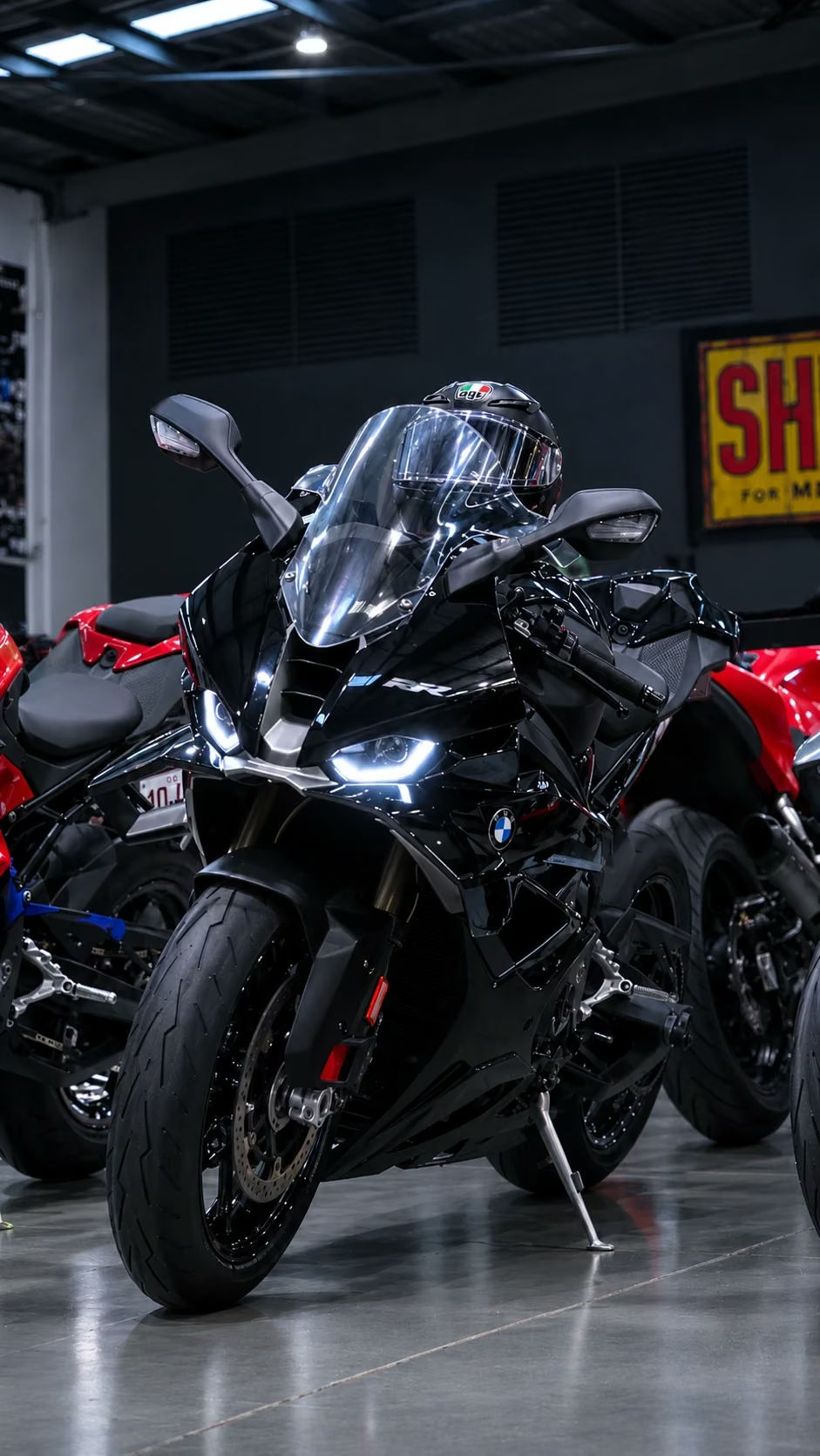
01 Ignition
S 1000 RR
2025/The Machine
Gloss black, lights on, red only where it counts. This is not a brochure bike. It is one particular S 1000 RR, photographed by its owner, taken apart here with numbers BMW will stand behind.
- Rated power
- 210hp
- Peak torque
- 113Nm
- Claimed top speed
- 303km/h
- Road-ready
- 198kg
BMW Motorrad Australia model figures. Sources
Begin the walk-around02 Anatomy
Walk around
the machine.
One photograph, from the level above, in a concrete car park. Every point below is placed on this bike — not a press render. Select a component to light it.

01 / 08
LED headlight
03 Aerodynamics lab
Air that
holds you down.
The 2025 winglets push the front of the bike into the road. Choose a speed and watch the force BMW publishes for this model build — and see why it grows so quickly.
Airflow lines are illustrative — not CFD or wind-tunnel data.
23.1kg
Winglet downforce, expressed as kilogram-force equivalent BMW
- As force
- 226.5 N Derived
- vs. 198 kg road-ready mass
- 11.7% Derived
- Previous winglets at 300 km/h
- 17.1 kg Press
| Speed (km/h) | Downforce (kg) |
|---|---|
| 150 | 5.9 |
| 200 | 10.6 |
| 250 | 16.03 |
| 300 | 23.1 (previous generation 17.1) |
What the number means
The winglets generate an aerodynamic force pressing the front wheel into the road. BMW quotes it in kilograms because that is easy to picture: at 300 km/h the push equals the weight of a 23.1 kg mass. The bike does not get heavier when parked — the load only exists while air is moving over it.
Why it climbs so fast
Aerodynamic force rises with the square of airspeed. Double the speed and the force roughly quadruples. Scale the 300 km/h figure by (v/300)² and you land within about 0.3 kg of each of BMW's other published points — the dashed line on the chart is that calculation, not data.
Against the old wings
BMW says the redesigned winglets give up to 37% more downforce than the predecessor. Press reporting of BMW figures puts the previous design at 17.1 kg at 300 km/h, against 23.1 kg now — a 35% increase on that basis. More front load helps resist wheel lift under hard acceleration and keeps the front settled at speed.
04 The inline-four
Four cylinders.
Thirteen thousand
seven hundred fifty.
999 cc, sixteen titanium valves and a camshaft that changes its mind. Sweep the rev range to see where BMW's two headline numbers live.
11,000rpm
Peak torque: 113 Nm
The dial marks only BMW's two published points. No power or torque curve is shown because BMW does not publish one in the sources used.
- Mean piston speed at this rpm
- 18.2 m/s Derived
- Combustion events per second
- 367 Derived
Cylinder animation is a slowed illustration of four pistons, not timing data.
BMW ShiftCam
ShiftCam gives each intake valve two cam profiles. The milder one opens the valve less, which suits smooth, part-throttle running.
Illustration, not to scale. BMW does not publish the switch-over point in the sources used, so none is shown.
- Swept volume
- 999cc BMW
- 80 × 49.7 mm, × 4
- 999.2cc Derived check
- Compression
- 13.3:1 Press
- Valves
- 16titanium BMW
- Specific output
- 210hp / litre Derived
- Bore : stroke
- 1.61: 1 Derived
05 The 58° difference
Fourteen degrees
of wrist.
The 2025 bike's quick-action throttle reaches full opening in 58° of grip rotation. The previous grip needed 72°. Turn the grip and compare.
- Previous grip turns
- 72.0°
- 2025 grip turns
- 58.0°
- Saved
- 14.0°
Same hand, same intent, 19.4% less rotation for the same throttle opening. That matters most at the exit of a slow corner: full throttle arrives without your hand having to roll over the top of the grip, or let go and re-grip.
BMW 58° and the 14° reduction. Press previous 72°. Derived 19.4%. The throttle is ride-by-wire; rotation maps to opening as drawn for illustration.
06 Electronic control
Seven ways
to ride it.
From 2025, all seven riding modes are standard — including the three configurable Race Pro modes that used to be optional.
RAIN
Relative sportiness, for orientation only — not a BMW settings value
Rider-configurable: throttle response · engine braking · traction control · ABS Pro
Educational demonstration. This interface is an original design, not BMW's TFT, and does not communicate with any motorcycle.
07 The numbers
Measured
in millimetres.
1,457 mm wheelbase
Full specification27 rows · source and basis for each
| Item | Value | Basis |
|---|
08 Real photography
Three frames.
One bike.
No renders, no stock, no extra angles invented. These are the owner's photographs, shown whole. Select one to view it full screen.
1 / 3
09 Final frame
Parked in the dark.
Still loud.
Lights on in an empty car park, engine cold, tank red. Everything on this page comes back to that one machine — the numbers only explain why it looks the way it does standing still.
— Sources & method
Where every number comes from.
- BMW Published by BMW Motorrad for the model. Not a measurement of this individual motorcycle.
- Press Reported by motorcycle press, generally restating BMW material.
- Derived Arithmetic done by this site from the figures above.
- Illustrative A visual explanation. Not measured data.
Not claimed here
No dyno figures, lap times, braking distances, telemetry or personal speed runs. No performance effect is claimed for the aftermarket silencer. US-market figures (such as a 205 hp rating) are not mixed with Australian ones. The 0–100 km/h time requested in the brief was not found in an Australian BMW source for this model and is therefore omitted.